Why Meditation Feels Hollow: Jung's Warning to the West
You have paid for your silence with a currency your own history does not recognize. It is 3 AM, and you are staring at a blinking cursor or a darkened ceiling, wondering why the fifteen minutes you spent on a frayed yoga mat earlier today did not translate into peace. You followed the instructions. You watched your thoughts pass like clouds. Yet, beneath the performed calm, there is a rusted iron gate in your chest that refuses to budge.
The answer is not that you are failing the practice, but that the practice is failing your specific ground. Carl Jung’s warning is that for a Western mind, borrowed stillness often functions as a lid on the unconscious, pressing down the very signals—the grief, the unasked questions—that are trying to guide you toward wholeness. When you treat your inner life as a series of distractions to be exhaled, you are not finding yourself; you are politely asking yourself to disappear.
The Crisis of the Empty Container
There is a specific weight to the silence when a car engine stalls in the middle of a busy intersection. It is not the silence of peace; it is the silence of a mechanism that has reached the end of its utility. This is the experience many encounter in their late thirties or forties—the dawn of what Jung called the second half of life. You have spent decades building the container: the career, the reputation, the social structure. You have become a master of achievement.
But suddenly, the container feels hollow. The ticking grandfather clock in the hallway seems to count down toward a void rather than a destination. In this moment, the urgency to find a solution often leads to a desperate adoption of inner techniques. You seek to "quiet the mind" because the mind has begun to ask questions you are not prepared to answer. You are attempting to stop choosing one side of yourself by silencing all sides at once.
Jung observed that the first half of life is about social adaptation—building the ego. The second half is about individuation—the process of becoming the person you were always meant to be. If you use a practice designed for the dissolution of the self to manage a crisis that requires the rebuilding of the self, you are simply postponing the inevitable confrontation with the rusted iron gate.
The Ten-Minute Engagement (PR2)
Set a timer for exactly ten minutes. Sit with a leather-bound journal and a heavy copper bowl or any singular, cold object. Do not close your eyes. Do not try to empty your mind. Instead, focus on the low hum of dissatisfaction you usually try to breathe away. Ask it: "What do you want from me?" Write down whatever image or phrase arises, no matter how irrational. This is not about calm; it is about contact.
The Anatomy of a Borrowed Map
A stained-glass window in a cathedral does not speak the same language as a mountain pass in the Himalayas. Jung’s critique was not of the Eastern traditions themselves—which he revered as peak achievements of human consciousness—but of the Western attempt to transplant them. He argued that the Western psyche is built on a specific, two-thousand-year history of tension and moral conflict. This history is in your blood and bone, regardless of what you believe intellectually.
When a practitioner in the East speaks of ancient energies, they are drawing from a soil that has been cultivated for millennia. For them, the map and the ground are one. For the Westerner, these words are often just concepts—intellectual abstractions used to bypass the "damp earth" of their own personal and cultural shadow. You are trying to walk a road using a map of a different continent, and you are surprised when you keep tripping over the roots in your own garden.
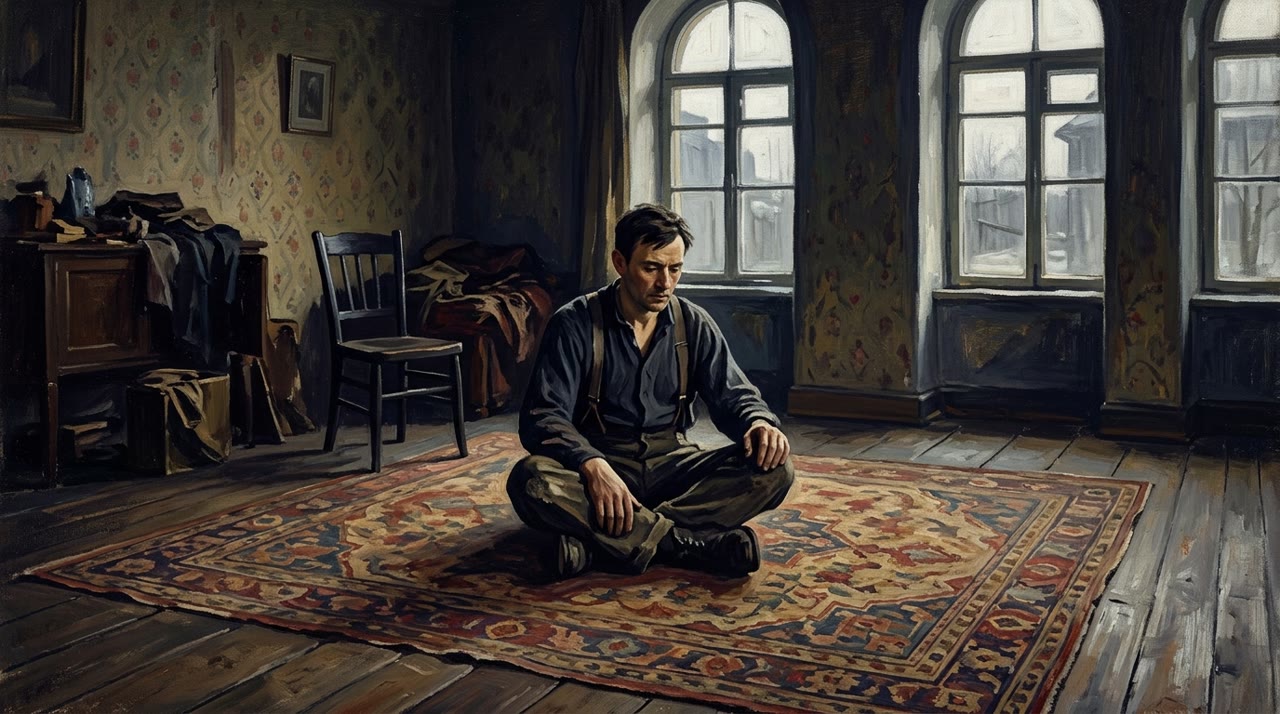
The divergence between borrowed stillness and indigenous depth.
This bypass creates a peculiar kind of spiritual fatigue. You may find yourself more "peaceful" in the short term, but also more disconnected from your actual life. You become a ghost in your own story, exhaling the very emotions that are meant to be the fuel for your transformation. You might even find that you wake up feeling behind because your inner practice has become just another task on a list, rather than a meeting with the Self.
While these words describe the architecture of the mind, the video carries the specific cadence of the silence between Jung's sentences—a texture of warning that no text can fully replicate.
The Signal Hidden in the Low Hum
The "low hum of wrongness" you feel during a meditation session is not a distraction. It is a signal. Jung suggested that the unconscious is not a basement for repressed memories, but a creative force. It uses the language of images, sudden grief, and physical discomfort to communicate. When you label this as "resistance" and return to your breath, you are hanging up the phone while the most important caller of your life is trying to get through.
This caller is the Self—the capital-S Self that Jung distinguished from the ego. The ego is the driver of the car; the Self is the entire landscape, the car, and the destination combined. The Self has a direction. It has a motion. It surfaces in the early hours when you feel small around certain people or situations, signaling that your current "container" is too tight for the person you are becoming.
By treating every thought as a cloud to be watched, you lose the ability to distinguish between the debris of the day and the gold of the unconscious. The Western psyche does not need more emptiness; it needs more engagement. It needs to look at the rusted iron gate and ask who holds the key, rather than sitting in front of it and waiting for it to dissolve into thin air.
Beyond Silence: The Act of Engagement
Jung’s alternative to the "emptying" practices of the East was what he called Active Imagination. This is the indigenous yoga of the West. It does not ask you to let the images pass; it asks you to enter them. If a figure appears in your mind’s eye, you speak to it. If a feeling of dread arises, you give it a shape and a voice. You treat the contents of your unconscious with the same reality you grant to the person sitting across from you at dinner.
This is a confrontation. It is noisier than meditation. It is messier. It involves the weight of a heavy winter coat being taken off—the sudden chill of exposure followed by the relief of freedom. It is the process of turning the lid into a door. Instead of suppressing the "one-sidedness" of the Western mind, you use it to build a bridge between the conscious and the unconscious.
| Feature | Borrowed Stillness | Indigenous Depth |
|---|---|---|
| Goal | Dissolving the ego into silence | Integrating the ego with the Self |
| Method | Watching thoughts pass like clouds | Engaging images as living realities |
| Result | Temporary calm, potential bypass | Individuation and meaningful motion |
| View of Conflict | Resistance to be exhaled | A signal to be investigated |
The transition from imitation to contact is the true turn of the second half of life. It is the moment you stop trying to be "spiritual" and start trying to be whole. Wholeness includes the darkness, the history, and the specific symbols of your own life. It is the only way to ensure that when you sit in silence, you are not sitting alone in an empty room, but are truly at home with yourself.
Frequently Asked Questions
Is Jung saying I should stop meditating entirely?
Not necessarily. He is warning against using meditation as a tool for suppression. If your practice makes you more disconnected from your actual problems or emotions, it is functioning as a lid. The goal is to move from passive observation to active engagement with the messages your psyche is sending.
What is the "low hum" I feel during quiet moments?
Jung would call this the voice of the unconscious or the Self. It is the feeling that the life you have built no longer fits the person inside. It is not something to be "breathed away," but a compass needle pointing toward the next stage of your development.
How do I start "Active Imagination"?
Begin by noticing the images or feelings that repeat in your dreams or during quiet moments. Instead of letting them pass, give them your full attention. Ask them what they represent. This dialogue is the foundation of Jungian inner work and leads to genuine individuation.
Why does this hit specifically in midlife?
The first half of life is dedicated to building a social identity. In the second half, that identity often becomes too small. The "hollowness" is the signal that the ego must now serve the Self, rather than the other way around. It is a transition from building the container to filling it.
Tomorrow morning, when the alarm goes off and the urge to open a breathing app strikes, don't reach for the borrowed map. Reach for the rusted iron gate. The key is not in a distant mantra, but in the very question you have been trying to silence. Write CAREFUL in the YouTube comments if you recognize the hum.
Continue Reading
Stop Choosing One Side of Yourself — How to integrate the shadow according to Carl Jung.
Why You Wake Up Feeling Behind — Breaking the morning story that dictates your day.
Why You Feel Small Around Certain People — Understanding the structural hinges of your personality.