
Feeling Trapped Inside Your Body: What Happens When the Perimeter Drops
You have spent decades paying for an unexamined contract: the quiet conviction that who you are begins at the scalp and terminates at the soles of your shoes. That single assumption converts your ribs, throat, and temple bones into an unforgiving private cell where every unresolved worry reverberates against bone. When you are feeling trapped inside your body, you do not need an exotic departure from this world; you need to understand that awareness was never contained within the meat to begin with. The skin is a sensory threshold, not a locked container. True ease arrives the moment identity shifts from defending an anxious personal border to inhabiting life as an open channel, as simple and unpretentious as a straw broom resting against a lime-washed wall.
Why Does Stillness Feel Like Being Trapped in a Skull?
You pull the blinds shut, cross your ankles on a woven rug, and instruct your thoughts to come to a clean stop. Within forty seconds, the exact opposite occurs: the radiator pipes clank, your jaw tightens into a rigid vice, and three years of delayed administrative chores parade behind your closed eyelids. You sit there feeling less like a calm seeker and more like an exhausted watchman chained inside an iron turret. When you stare at your faint gray reflection in a locked phone while waiting at a red light during a cold morning commute, the face peering back looks like an absolute boundary. You automatically assume that everything inside that pale forehead belongs to your solitary suffering, while everything beyond the windshield belongs to an indifferent universe.
This structural claustrophobia is why modern attempts at quiet contemplation frequently cause panic. People attempt to manufacture peace by locking themselves tighter inside their mental fortress, unaware that attention builds walls the instant it turns inward to inspect its own distress. You squeeze your brow, monitor your diaphragm, and wonder why the cage feels heavier with every passing minute. Mukunda, the headstrong youth who would later be known across the globe as Paramahansa Yogananda, suffered from that precise misunderstanding. Convinced that the bustling streets of Calcutta were suffocating his inner clarity, he abandoned his family duties and fled toward the frozen heights of the Himalayas. He expected the snowy granite crags to give him the spaciousness his own skin denied him.
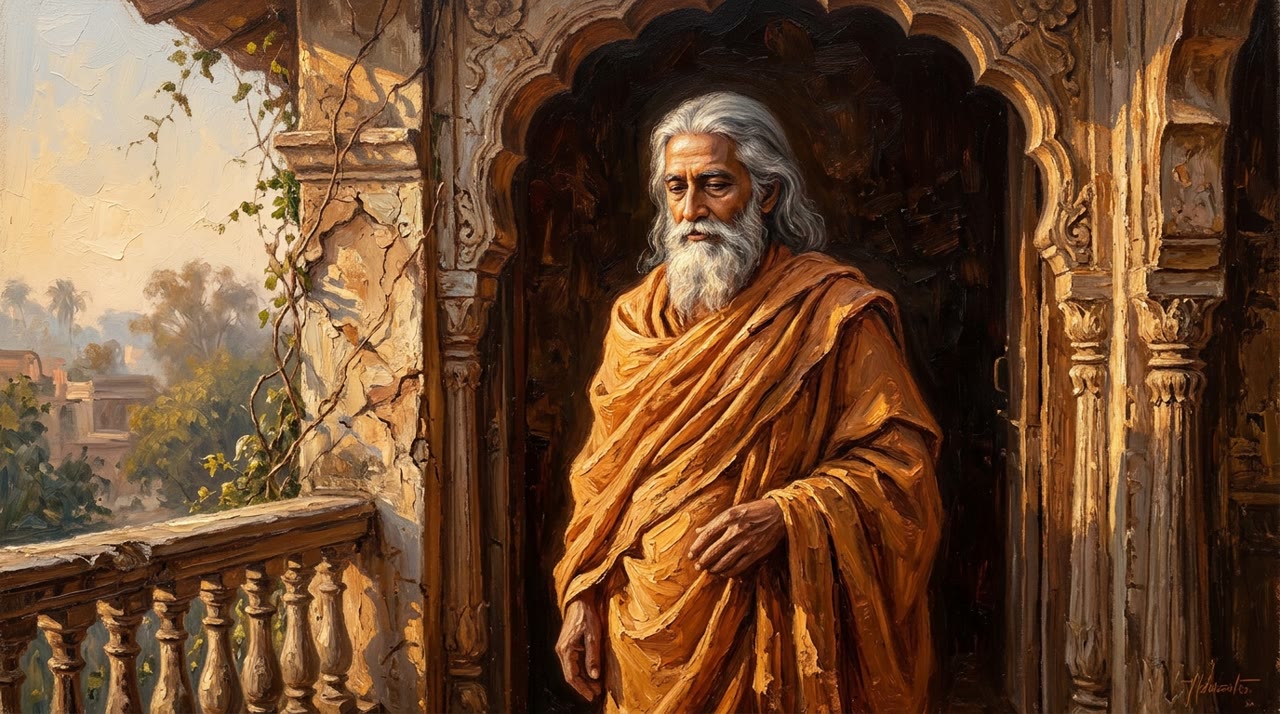
The wilderness provided no miraculous liberation. He returned down the rocky slopes with bruised heels, humbled and dreading the sharp reproof of his teacher, Swami Sri Yukteswar. Yet when the boy stepped back into the hermitage courtyard, expecting thunderous condemnation for his desertion, the elder simply rose from his seat and proposed that they stroll to the kitchen together to prepare a meal. That mild, grounded welcome disarmed the young man far more thoroughly than anger ever could. Sri Yukteswar remarked that frustration only develops when selfish expectations are denied; because he demanded nothing from the boy for personal vanity, nothing could disturb his peace. Still, the student harbored the stubborn belief that silence had to be wrestled down through severe personal force. The stage was set for a sharp inversion that would dismantle his understanding of the flesh entirely.

The Physical Shock That Unlocks the Perimeter
A few mornings after his failed mountain retreat, Mukunda climbed to the upper balcony of the ashram, determined to conquer his unruly thoughts through muscular concentration. Sitting on the hard stone, his mind behaved like dry leaves caught in a coastal squall. From the far corner of the courtyard, Sri Yukteswar called up to him. The young man ignored the summons, muttering sullenly under his breath that he was engaged in serious inner devotion and should not be interrupted. The teacher shouted back with unflinching clarity, noting that he could see precisely how the boy was sitting: rigid, agitated, and wrestling fruitlessly with his own mental dust.
Defeated and humiliated, Mukunda walked down to the veranda to stand before the elder. Sri Yukteswar looked at him with an affection completely stripped of condescension, gently observing that the cold Himalayan snows had failed to deliver the vastness he sought. Then, stepping forward, the teacher struck the young student softly on the center of the chest, directly above the sternum bone. What followed was not a gradual drift into imagination, but a sudden sensory overhaul that abolished the physical perimeter in an instant.
Breath was pulled from his lungs as if caught in the vacuum of a massive tide. His limbs remained grounded on the balcony tiles, but the sensation of being confined behind two eyes vanished completely. His field of vision blossomed from two narrow forward-facing slits into a panoramic sphere that took in every coordinate at once. Gazing through what had previously been the back of his head, he observed a white cow wandering casually through the outer lane. When the animal moved behind a solid brick courtyard wall, the masonry presented zero obstacle; the cow remained visible in fine detail. Tree roots coursed through the dark earth below like pulses of green sap through translucent glass. He recognized with startling lucidity that judgment decides wound harm when it creates artificial partitions, whereas raw awareness simply registers what is, unimpeded by stone, skin, or distance.
The entire panorama did not feel like an exterior landscape he was observing from a distance. The center of that staggering expanse felt stationed inside his own heart. He was not an isolated physical speck straining to maintain its boundaries on a dusty planet; he was the entire living field observing a single physical frame resting by a balcony railing. The French physiologist Charles Richet once observed that nature conceals her deepest mechanics not by hiding them in darkness, but by placing them in plain view before observers blinded by pre-existing habits. We routinely presume that our eyes manufacture vision, just as a child might assume a wooden radio cabinet creates the violin concerto streaming from its fabric mesh. In truth, the bodily senses do not originate consciousness; they merely pinch a limitless ocean of awareness down into a manageable trickle of functional data.
The Salt Figurine and the Balcony Floor
The vast panorama did not last indefinitely. With the suddenness of an iron snap, air rushed back through Mukunda’s windpipe, filling his chest with a heavy, leaden ache. The vast horizon collapsed back into the familiar narrow limits of his rib cage. Looking down at his dusty sandals, a wave of profound sorrow broke over him. He felt like an heir who had spent an hour roaming the halls of an ancestral estate, only to be dragged back and locked inside a damp wooden kitchen cupboard with an iron latch. Tears of gratitude and bereavement sprang to his eyes as he leaned forward to touch the elder's feet in reverence.
Sri Yukteswar caught him firmly by the collar and pulled him upright with uncompromising briskness. The teacher gave a direct instruction: he told the boy not to behave like a drunkard wallowing in emotional revelry. The morning was passing, and practical obligations required completion. He ordered the young man to fetch the straw broom leaning against the wall, sweep the dried mud off the balcony tiles, and prepare for an ordinary walk down to the river bank. The instruction sounded almost callous following an encounter with cosmic foundations, yet that broom was the absolute fulcrum of the teaching.
Imagine a figurine molded from coarse sea salt that has stood for years on a high river embankment, endlessly fretting over its distinct edges, dreading the damp breeze, and guarding its fragile silhouette. One morning, an unexpected wave rolls up the clay slope, saturates the figurine’s base, and sweeps it out into the current. For a fleeting instant, the form experiences sheer terror as its defined elbows and jaw dissolve into the spray. But immediately thereafter, it recognizes that the salt of its little frame is identical in substance to the ocean itself. Nothing real perished; only the brittle illusion of separation washed away. When the tide recedes, the river still flows through the mud, and water must still travel to the delta. Realizing your nature does not exempt you from washing the breakfast pans.
Practice: The Perimeter Substitution
You cannot sit on your living room rug waiting for an ancient sage to strike your breastbone with an electric hand. What occurred between Sri Yukteswar and his pupil was the culmination of years spent stripping away petty mental cravings until the inner system was entirely receptive. You can, however, dismantle the reflexive clamping of your bodily perimeter right now through a concrete physical substitution whenever claustrophobia mounts.
The moment you notice yourself hunching over a steering wheel or leaning over a porcelain sink with aching shoulder blades after scrubbing an iron skillet, your physical system has defaulted to fortress mode. Instead of attempting to silence your thoughts through brute willpower, perform this bodily swap:
The Three-Point Spatial Substitution
1. Identify the Physical Anchor: Notice the involuntary knotting in your body—almost always located in the tight muscles of the brow, the clenching molars, or the shallow tension held high in the pectoral plates.
2. Swap Focal Stare for Peripheral Horizon: Without turning your neck, immediately widen your visual field to take in the outermost boundaries of the room. Notice the ceiling corners, the baseboards, and the space between your elbows and your ribs simultaneously.
3. Reframe the Center of Observation: Deliberately assign the act of witnessing not to the dark space behind your forehead, but to the quiet air that occupies the room itself. Let the room hold the body, rather than forcing the body to hold the room.
This substitution halts the feedback loop that turns bodily sensation into claustrophobic panic. You stop treating your skull as the defensive perimeter of life, adopting instead the stable posture of the low ground power valley spirit, which receives every impact without pushing back against reality.
Two Ways to Inhabit the Physical Frame
Understanding the distinction between treating your flesh as an anxious prison versus an open instrument is what prevents daily responsibilities from degenerating into chronic exhaustion. The table below lays bare the practical mechanics of these two stances across common experiences.
| Operational Dimension | Perimeter Consciousness (Fortress) | Instrument Consciousness (Window) |
|---|---|---|
| Locus of Identity | Confined inside the skull and ribs; fundamentally separate from the room. | Awareness holds the room; the physical form operates as an open conduit within space. |
| Sensory Obstacles | Walls, ambient noise, and fatigue register as invasive personal threats. | Physical boundaries register as functional textures within the perceptual field. |
| Breath Pattern | Shallow, rapid, held tightly high in the chest to guard the heart center. | Rhythmic, unobstructed, flowing effortlessly without muscular clamping. |
| Domestic Labor | An exhausting punishment that interrupts personal spiritual goals. | The natural and necessary cleaning of the floor; sweeping the tiles without vanity. |
| Response to Fatigue | Bitter resentment, panic over aging, frantic search for mountain escapes. | Objective recognition that the tool needs rest, without identifying identity with weariness. |
Frequently Asked Questions
Does feeling trapped inside your body mean you have an anxiety disorder?
Not necessarily. While acute anxiety intensifies muscle tension, the sensation of being confined behind your eyes is a widespread cognitive habit. It stems from constantly monitoring private thoughts while treating the skin as an absolute perimeter, turning ordinary bodily sensations into an internal echo chamber.
Can a sudden physical touch actually trigger expanded awareness?
A physical strike carries no automatic magic. In historical accounts like Yogananda’s, the touch functioned because the student had spent years quieting personal demands, leaving the nervous system completely primed. Without deep prior internal readiness, a sudden strike simply registers as an ordinary physical blow.
What should you do when physical chores cause deep mental irritation?
Notice the silent demand that your attention should be somewhere more elevated. Resentment builds when chores are viewed as an obstacle to peace. Treat the task itself—washing a pan or sweeping dust—as the entire field of reality, executing the motion without claiming personal ownership of the outcome.
How does widening peripheral vision stop mental claustrophobia?
Narrow focal vision activates sympathetic nervous arousal, locking attention onto perceived threats. Shifting into wide peripheral awareness naturally engages parasympathetic pathways, relaxing the facial muscles and breaking the unconscious habit of treating the forehead as a defensive battleground.