Your Own Judgment Decides Whether You Can Be Wounded
Why is it that a sharp sentence from a stranger can ruin your entire evening, while the same words on a different day barely register as noise? You have likely asked yourself why your internal peace feels like a swinging cedar gate, unlatched and rattling in the wind, at the mercy of every passing gust of malice.
| The Event | The Brittle Reaction (Impact) | The Pliant Response (Verdict) |
|---|---|---|
| A public correction | Internal collapse; a sense of diminished status. | Information received; status is an external opinion. |
| A mocking tone | Rage or defense; the "sting" is accepted. | Acoustic observation; the speaker's noise stays with them. |
| A digital dismissal | Obsessive repetition; the screen dictates the mood. | The black glass is ignored; the judgment is withheld. |
The Internal Translation Desk
Imagine stepping into a crowded elevator. The air is thick with the scent of wet wool coats and cold metal. As the elevator buttons glow, someone drops a remark about your recent failure, loud enough for everyone to hear. In that instant, your neck burns and your stomach tightens like a rope pulled around a capstan. You carry that ride down twenty floors and out into the gray drizzle of the street, replaying those six syllables until your fists cramp in your pockets.
Yet, if that same person had spoken those words in a dialect you didn't understand, you would have nodded politely and walked away unbruised. The malice was the same. The speaker’s intent was identical. The only difference is that in the second scenario, your mind couldn't translate the noise into a weapon. This proves the strike does not live in the speaker's mouth; it lives in the value you assign to the sound.
We often treat a harsh voice like a thrown stone that tears tissue regardless of our consent. But an utterance has no hands. It carries no weight except the weight you hand over to it as it crosses the room. This mechanism of internal translation is the hidden floor of every human interaction, and understanding it leads directly to the concept of the empty house.

The Paradox of the Empty House
[[MISSING: MASTER PHOTO]] Seneca, writing two thousand years ago, offered a perspective that reframes the very nature of an attack. He describes a prowler who snaps an iron latch in the dead of night, creeps across the floorboards with a pry bar, and finds the home stripped entirely bare. There is no silver on the table, no bread in the pantry, and no tapestries on the walls. The thief has performed every motion of a burglary, yet no one was robbed.
This is how a mind functions when it refuses to ratify an external assault. The attacker can bring the full force of their spite, their careful aim, and their public theater. But if your interior possesses nothing that consents to be seized—if you do not value their opinion or accept their premise of your "diminishment"—the attack fails. The thief leaves sweating and frustrated, while you sleep through the night without losing a single coin of your peace.
This does not mean the world stops being difficult. You still have to pay the electric bill and take out the trash. It means you stop running an unpaid hospitality service for every stray jab in the district. When you realize that your attention is quietly building the walls of your own prison, you begin to see the specific sequence that allows a wound to form.
The Anatomy of the Biological Flutter
There is a biological reality we cannot ignore. When a horn blares behind you in a rainy grocery parking lot, your pulse leaps. This sudden flutter is involuntary; nature gives you that startle, and no philosophy forbids it. It is simply disturbed air striking the tiny bones inside your skull. The error happens in the third act: the moment you evaluate the impression.
You tell yourself that you have been wronged, and the moment you whisper that agreement, the puncture appears. Marcus Aurelius famously reminded himself to "wipe out the judgment," knowing that the complaint vanishes the moment the verdict is withdrawn. It is like washing grease off your knuckles at the kitchen sink—you feel the cold water, you see the grime, but you don't have to become the dirt.
When you are forced into a real moment by external pressure, the mind acts like a sphere on rough ground. The ground provides the slope, but the rolling motion belongs to the shape of the ball. If you remain whole, the jagged edges of the terrain cannot change your fundamental nature. This leads us to the secret of the cooper's wood.
The Cooper’s Secret: Strength Through Pliability
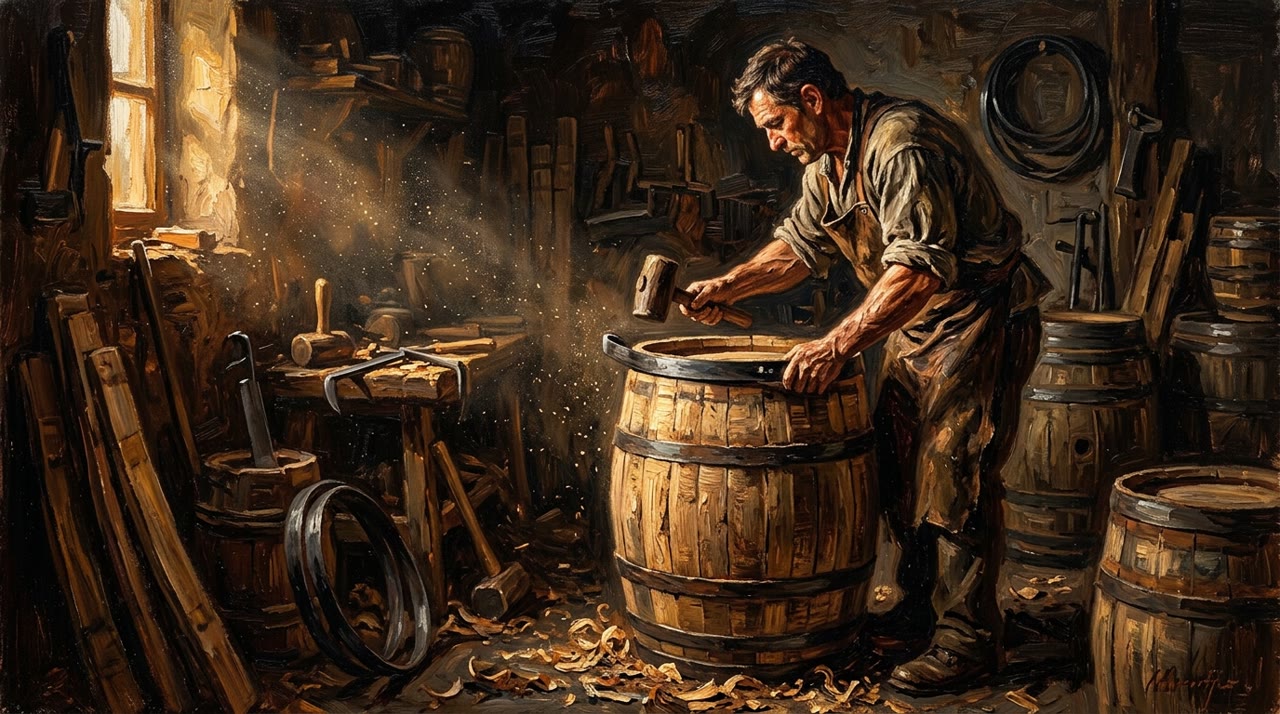
A craftsman fitting wet wooden staves into iron hoops knows that brittle timber is a liability. If the wood is dry and rigid, it snaps under the pressure of the hoop, ruining the barrel and wasting the wine. Instead, the cooper steams the wood. He makes it pliant until it accommodates the curve without splitting. The barrel stays whole not because the wood fought the iron, but because it yielded its outline without surrendering its fiber.
Water demonstrates this even more clearly than wood. Pour a ceramic jug of river water against a granite ledge. The water does not clench its jaw or harden its surface to defend its dignity. It simply divides, flows through the crevices, and rejoins itself on the other side. It loses nothing of its volume because it refuses to turn rigid against the rock. When you stop resisting the "fact" of someone's speech and start withdrawing your "judgment" of it, you become the water.
The next time a verbal strike lands, remember that the debtor holds an empty promissory note until you choose to confirm the debt. You can keep your hands folded behind your back. If you do not reach out to take the parcel of shame, the courier has no choice but to carry it back to his own car. The following practice outlines how to perform this substitution in the heat of the moment.
Practice: The Verdict Substitution
This exercise requires no equipment and can be performed in any crowded hallway or heated meeting. It is a simple swap of one habitual internal gesture for another.
- The Trigger: You feel the "sting" of a comment. Your pulse rises, your face warms, or your jaw tightens.
- The Habitual Gesture: You immediately ask, "How could they say that?" or "What does this say about me?" This is the signature on the contract.
- The Substitution: Interrupt the sentence. Replace it with: "A sound has reached my ear. Does this sound have the power to change my character?"
- The Outcome: By categorizing the event as "acoustics" rather than "injury," you withhold the judgment that creates the wound.
Frequently Asked Questions
Does this mean I should let people treat me poorly?
Not at all. Withdrawing your judgment is about your internal state, not your external boundaries. You can walk away from a toxic situation or address a grievance with total clarity precisely because you aren't wounded. A mind that isn't bleeding makes much better tactical decisions than one fueled by personal resentment.
How can I stop the physical "flutter" of my heart when I'm attacked?
You don't have to stop it. That is a biological startle response. The goal isn't to become a statue, but to realize that the flutter is just weather. It passes. The wound only becomes permanent when you interpret that heart-rate spike as proof that you have been diminished or harmed by the other person.
Isn't this just a way of suppressing my feelings?
Suppression is pushing a feeling down while still believing the cause is valid. This is the opposite: it is seeing that the cause has no inherent power over you. When you truly realize that clinging to an external opinion is what causes the pain, the need to suppress the feeling disappears because the feeling loses its foundation.
A Right to Your Own Verdict
You are hereby granted the right to stop being a vessel waiting to be cracked by an untrained hand. You are the sole authority permitted to sign the indictment against your own peace. If someone hands you a parcel of shame and you refuse to open it, the contents remain their property, not yours.
Look back at that cedar gate in your mind. The wood is dry and the posts are anchored deep into the dirt. You no longer have to listen to it rattle and bang with every passing breeze. Reach out your hand and drop the iron latch into the receiver. The wind can blow until morning, but the door remains entirely shut from within. You have redefined what it means to be struck, and in doing so, you have become impossible to wound.
Continue Reading
The More You Cling to Loved Ones the Less You Live
Discover why the attempt to control external sources of happiness always results in a loss of self.
A Major Illness Can Force You Into the Only Real Moment
How physical limitations can strip away the noise and reveal the internal strength you didn't know you had.
Your Attention Is Quietly Building The Walls Around You
A deep dive into how the things you focus on become the boundaries of your reality.